
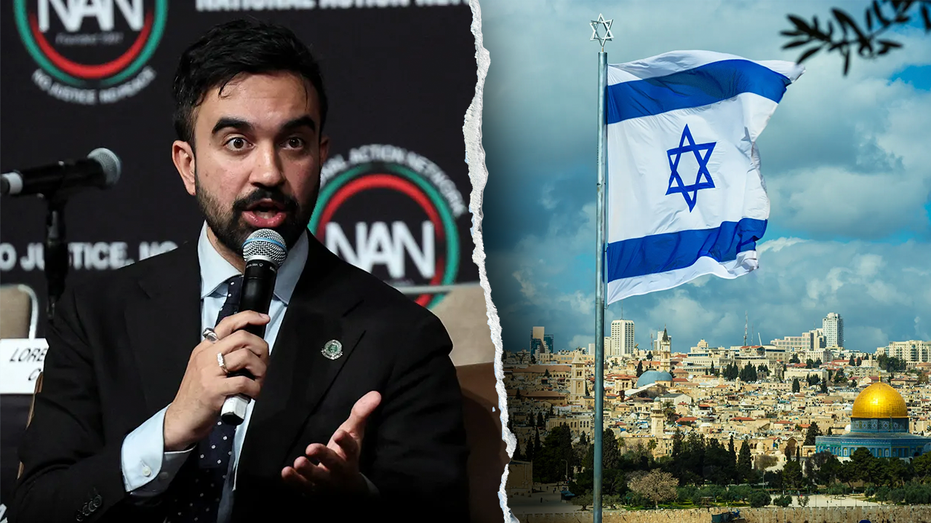
For a man elected to run New York City, Zohran Mamdani spends a remarkable amount of time thinking about Israel.
Before he has solved the city’s affordability crisis, before New Yorkers feel safer on the subway, before families see cleaner streets, better schools or a government that simply works, the socialist Mamdani has chosen to make the Jewish state and its leader a defining obsession — Israel and Benjamin Netanyahu.
He has publicly declared that he would seek to have Israel’s prime minister arrested if Netanyahu came to New York. Whether or not such a thing could ever happen is beside the point. A New York City mayor has no meaningful role in international criminal law or American foreign policy. Yet this became one of Mamdani’s earliest and most high-profile priorities, and now he admits he doesn’t have the legal authority to do so.
Think about that. The mayor of America’s largest city looked across the ocean before looking across his own boroughs. That tells you something. It tells you where his passion lives. It tells you what keeps him up at night, and it tells you that, for all the campaign rhetoric about housing, transit and working families, Israel occupies an extraordinary place in his political imagination.
So, I’m calling him the first MIGA mayor: Make Israel Great Again. The pattern did not begin there.
Among the earliest actions of his new administration was revoking New York City’s adoption of the International Holocaust Remembrance Alliance’s working definition of antisemitism. Supporters argued that the definition could chill legitimate criticism of Israel. Critics saw something very different: a city stepping away from one of the world’s most widely used tools for recognizing modern antisemitism at a time when antisemitic incidents continue to rise.
That decision sent a message. Whether intended or not, many Jewish New Yorkers heard it loud and clear.
The administration also rolled back an executive order adopted under Mayor Eric Adams that had sought to prevent city agencies from discriminating against Israel, Israeli citizens and Israel-linked businesses through municipal contracting or procurement.
Again, supporters defended the change. Again, many Jewish New Yorkers saw a familiar pattern. One decision can be explained away. Two decisions become a trend. Three decisions become an agenda.
Then came reports that the administration’s international affairs office had planned a meeting with Iran’s ambassador to the United Nations before the proposal was abandoned. Mamdani later said he had not approved the meeting and called it a mistake. Perhaps. But the contrast was impossible to ignore.
THE US-ISRAEL STRATEGIC ALLIANCE – PARTNERSHIP, NOT CHARITY
An administration willing to explore dialogue with representatives of the Iranian regime while publicly entertaining the arrest of the elected leader of Israel naturally raises questions about its priorities.
None of this exists in isolation. Mamdani proudly identifies with a political movement in which hostility toward Israel has become increasingly central. For years, we have watched the same progression.
Occupy Wall Street, campus BDS campaigns, academic boycotts, the Democratic Socialists of America, the “Squad.” Every movement arrives promising economic justice.
Every movement eventually seems to discover that Israel has somehow become one of its defining moral causes. No country receives comparable scrutiny. No democracy is held to quite the same standard. No conflict consumes so much attention.
I know these worlds well. While I now live in Florida, I grew up in Brooklyn Democratic politics, where endorsements mattered, relationships mattered and neighborhood concerns came first.
CLICK HERE FOR MORE FOX NEWS OPINION
Later, my professional life became devoted to fighting antisemitism and introducing Americans to the Israel that headlines rarely capture: its innovation, diversity, culture, resilience and humanity. For decades those two worlds barely intersected. Then New York elected Zohran Mamdani. Now they have collided.
Many people were stunned to hear that Jewish voters helped elect him. The reality is more nuanced.
Available exit polling suggests that most Jewish voters supported Andrew Cuomo, not Mamdani. Yet a meaningful minority, particularly younger and more progressive Jews, backed him. Every voter has his or her reasons. Some cared almost exclusively about affordability, some believed municipal politics and Middle East politics should remain separate, and some assumed campaign rhetoric would give way to pragmatic governing.
The first months of this administration suggest otherwise. Israel is not an occasional topic for this mayor. It is a recurring theme. And that matters because New York is home to the largest Jewish community outside Israel.
For millions of New Yorkers, Israel is not an abstract foreign policy debate.
It is family.
It is faith.
It is history.
It is identity.
SIGN UP FOR ANTISEMITISM EXPOSED NEWSLETTER
When elected officials repeatedly single out the world’s only Jewish state for exceptional condemnation, many Jews do not experience that as ordinary political disagreement. It’s antisemitism.
They experience it as part of a climate that has made Jewish schools hire more security, synagogues install more barriers and Jewish students wonder whether expressing a connection to Israel will make them targets.
New Yorkers elected a mayor to obsess over New York, over crime, over housing, over sanitation, over schools. Over whether a family can afford to stay in the city.
Instead, they have a mayor who appears to reserve his greatest passion for litigating the legitimacy of a country nearly six thousand miles away. Every mayor leaves a signature. Some build parks, some reduce crime and some transform neighborhoods.
Zohran Mamdani is writing a different legacy. He is becoming the mayor who cannot stop talking about Israel while New Yorkers wait for him to focus on New York.
The Big Apple deserves a mayor whose first priority is the people who elected him. Instead, it has one who seems determined to fight battles far beyond the five boroughs.