
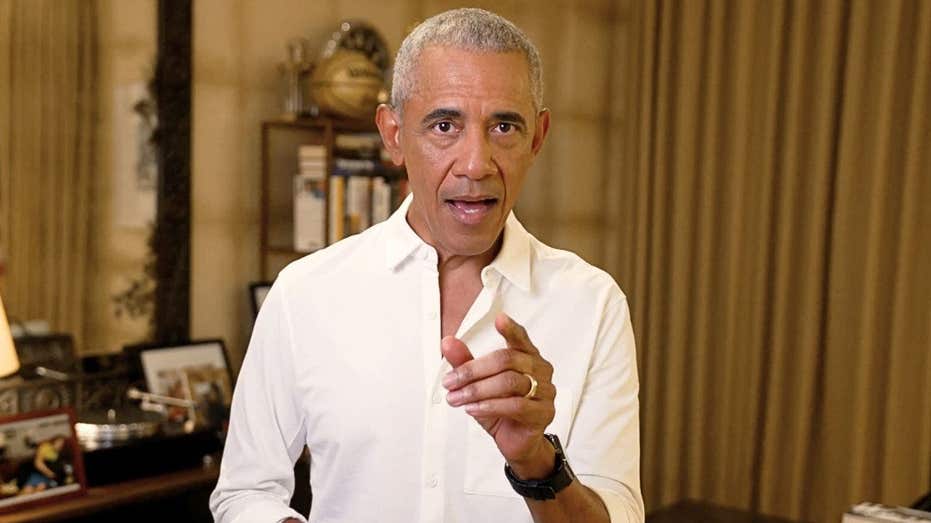
Former President Barack Obama is urging Virginians to vote in favor of a congressional redistricting ballot measure that if passed, could give Democrats a big boost in this year’s midterm elections.
“By voting yes, you have the chance to do something important — not just for the Commonwealth, but for our entire country,” Obama said in the video. “By voting yes, you can push back against the Republicans trying to give themselves an unfair advantage in the midterms.”
The video by the former president, who remains one of the most popular former presidents and whose favorable ratings among Democrats remain very high a decade after leaving the White House, was released Friday on the eve of the final day of early voting ahead of Tuesday’s statewide referendum.
If the ballot measure is successful, it would give the Democrat-controlled legislature — rather than the current nonpartisan commission — temporary redistricting power through the 2030 election. It could result in a 10-1 advantage for Democrats in Virginia’s congressional delegation, up from their current 6-5 edge.
OBAMA ENDORSES VIRGINIA REDISTRICTING CONSTITUTIONAL AMENDMENT THAT COULD HELP DEMS GAIN 4 SEATS
That would give Democrats four additional left-leaning U.S. House seats ahead of the midterms, as the party tries to win back control of the chamber from the GOP, which currently holds a razor-thin majority.
“By voting yes, you can take a temporary step to level the playing field. And we’re counting on you,” Obama said in the video.
Republicans call the Democrats’ redistricting effort an “unconstitutional power grab.” Democrats counter that it’s a necessary step to balance out partisan gerrymandering already implemented by Republicans in other states under the urging of President Donald Trump.
The video by Obama is the former president’s latest effort tied to the referendum. He has previously appeared in ads released by Virginians for Fair Elections, the Democrat-aligned group working to pass the ballot initiative.
Virginians For Fair Maps, the leading Republican-aligned group opposing redistricting, is using past comments by Obama against political gerrymandering in their ads opposing the referendum.
“Because of things like political gerrymandering, our parties have moved further and further apart, and it’s harder and harder to find common ground,” the former president says in a clip showcased in the spot.
A separate group that is also urging Virginians to vote no has sent mailers across the state featuring Obama’s image alongside a six-year-old quote from the former president saying, “For too long, gerrymandering has contributed to stalled progress and warped our representative government.”
Supporters of redistricting have dramatically outraised and outspent groups opposed to the referendum. But polling suggests support for the ballot initiative is only slightly ahead of opposition, amid a surge in early voting.
Virginia is the latest battleground in the high-stakes fight between Trump and the GOP versus Democrats over congressional redistricting.
BATTLE FOR THE HOUSE RUNS THROUGH VIRGINIA AS COURT OKS HIGH-STAKES REDISTRICTING VOTE
Aiming to prevent what happened during his first term in the White House when Democrats reclaimed the House majority in the 2018 midterms, Trump last spring first floated the idea of rare, but not unheard of, mid-decade congressional redistricting.
The mission was simple: redraw congressional district maps in red states to pad the GOP’s fragile House majority to keep control of the chamber in the midterms, when the party in power traditionally faces political headwinds and loses seats.
When asked by reporters last summer about his plan to add Republican-leaning House seats across the country, the president said, “Texas will be the biggest one. And that’ll be five.”
Republican Gov. Greg Abbott of Texas called a special session of the GOP-dominated state legislature to pass the new map.
But Democratic state lawmakers, who broke quorum for two weeks as they fled Texas in a bid to delay the passage of the redistricting bill, energized Democrats across the country.
Among those leading the fight against Trump’s redistricting was Democratic Gov. Gavin Newsom of California.
REPUBLICANS TARGET VIRGINIA GOVERNOR IN BID TO DEFEAT DEMOCRAT-BACKED REDISTRICTING
California voters in November overwhelmingly passed Proposition 50, a ballot initiative that temporarily sidetracked the left-leaning state’s nonpartisan redistricting commission and returned the power to draw the congressional maps to the Democratic-dominated legislature.
That is expected to result in five more Democratic-leaning congressional districts in California, which aimed to counter the move by Texas to redraw their maps.
The fight quickly spread beyond Texas and California.
Republican-controlled Missouri and Ohio, and swing state North Carolina, where the GOP dominates the legislature, have drawn new maps as part of the president’s push.
In blows to Republicans, a Utah district judge late last year rejected a congressional district map drawn up by the state’s GOP-dominated legislature and instead approved an alternate that will create a Democratic-leaning district ahead of the midterms.
Meanwhile, Republicans in Indiana’s Senate in December defied Trump, shooting down a redistricting bill that had passed the state House. The showdown in the Indiana statehouse grabbed plenty of national attention.
Florida is next up.
Two-term Republican Gov. Ron DeSantis and state lawmakers in the GOP-dominated legislature are hoping to pick up an additional three to five right-leaning seats through a redistricting push during a special legislative session that kicks off on April 28.
Hovering over the redistricting wars is the Supreme Court, which is expected to rule in Louisiana v. Callais, a crucial case that may lead to the overturning of a key provision in the Voting Rights Act.
If the ruling goes the way of the conservatives on the high court, it could lead to the redrawing of a slew of majority-minority districts across the county, which would greatly favor Republicans.
But it is very much up in the air — when the court will rule, and what it will actually do.