
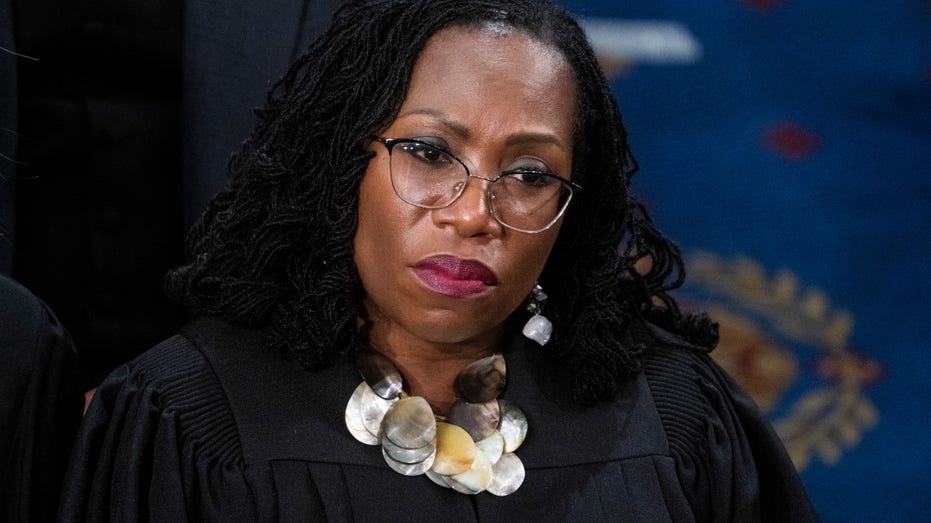
Justice Ketanji Brown Jackson protested the Supreme Court’s decision to use their recent ruling in a Louisiana gerrymandering case to instruct lower courts on how to define the Voting Rights Act, a move that could wipe out previous legal victories for voting rights groups.
The Court on Monday sent a Mississippi case back down to U.S. District Court “for further consideration” following their ruling in Louisiana v. Callais, which rejected race-based gerrymandering.
“This case presents only the question of Section 2’s private enforceability, which our decision in Louisiana v. Callais … did not address,” Jackson dissented, referencing Section 2 of the Voting Rights Act. “Thus I see no basis for vacating the lower court’s judgment.”
The Supreme Court last month limited the scope of section 2 of the Voting Rights Act, which restricts how states draw districts affecting minority voters, in its ruling in the case of Louisiana v. Callais.
Louisiana v. Callais centered on whether Louisiana’s 2024 congressional map, which had added a second majority-Black district, amounted to an unconstitutional racial gerrymander.
Though the justices acknowledged that compliance with the Voting Rights Act can be considered by states as a compelling interest in redistricting, they said that it did not require Louisiana to add the creation of a second, majority Black district, siding with a lower court that had also blocked the state’s use of the map.
JUDGES SAY THEY’LL REDRAW LOUISIANA CONGRESSIONAL MAP THEMSELVES IF LAWMAKERS CAN’T
The high court’s ruling in that case could trigger a new wave of legal challenges over congressional boundaries and make it harder for plaintiffs to challenge the maps in question, as it requires them to prove a racially discriminatory motive.
Fox News Digital’s Breanne Deppisch contributed to this report.