
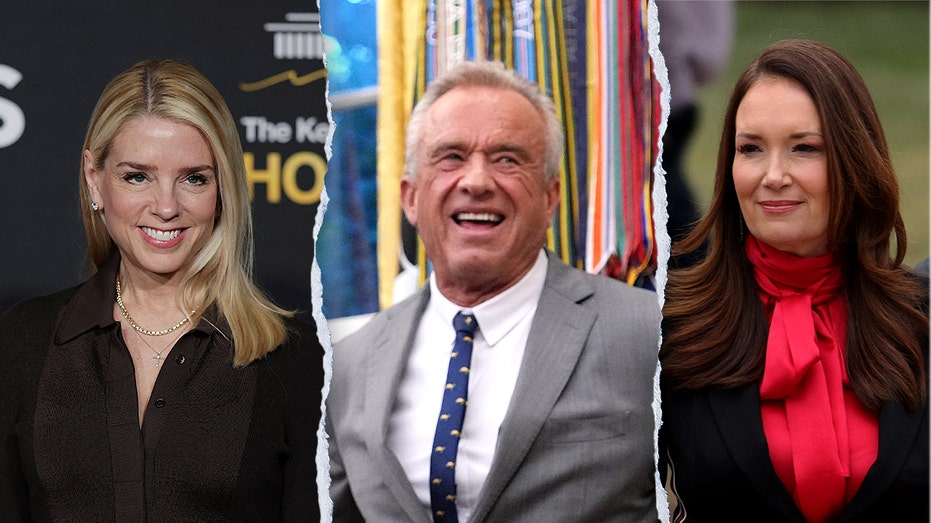
Senior officials in President Donald Trump’s administration say they are cracking down on animal cruelty, rolling out coordinated actions across the Justice Department, the Department of Agriculture (USDA) and the Department of Health and Human Services (HHS) to target dogfighting, puppy mills and animal testing.
“We are forming a strike force… and we’re going to have designated U.S. attorneys in every state to prosecute these [animal abuse] cases,” said Attorney General Pam Bondi on “My View with Lara Trump” on Saturday.
Bondi appeared with Agriculture Secretary Brooke Rollins and Health and Human Services Secretary Robert F. Kennedy Jr. to discuss their interagency animal welfare initiative.
Bondi said her department would work with the USDA to conduct special training for prosecutors and law enforcement agents on executing search warrants in animal abuse cases.
“We just last week convicted someone, for the first time ever, of using a firearm in a violent crime, and the violent crime was dogfighting,” Bondi said.
In another example that shows “no one is above the law,” Bondi told host Lara Trump that 190 dogs were seized from former NFL player LeShon Johnson.
“That was the most seized from one single defendant. So we’re coming after you if you’re going after these babies,” she said, holding a small black puppy named Guru in her lap.
RFK JR. ANNOUNCES ‘HISTORIC CRACKDOWN’ ON ‘BROKEN’ ORGAN DONATION SYSTEM
Secretary Rollins said the USDA is taking a tougher approach to shutting down abusive puppy mills, moving away from issuing warnings and toward stricter enforcement of the Animal Welfare Act.
“Compliance with the Animal Welfare Act, which is from the 1960s, was hovering around 65, 67% until the last few years. We’re now closer to 92%, but it’s that 8% that we’re really going to focus on.”
She described the poor conditions dogs can face in these mass-breeding operations. “No more puppy mills where you have puppies stacked on top of each other, where, if you don’t sell them, then you drown them in a barrel because it’s the cheapest way to do it.”
Kennedy said all the major sub-agency heads at HHS are “all deeply committed to ending animal experimentation.”
He said new studies on animal testing show “that the predictivity of animal models is very, very poor for human health outcomes. There are much more efficient ways of predicting human health outcomes. We are using, even in their nascent stages, computational modeling and AI,” which he said provides much better results.
The HHS chief said there are about 100,000 primates in research labs across the country.
“There are another 20,000 that are imported every year, and we’re very concerned about that. We’re trying to put an end to that completely,” he said, adding that his department was “re-educating researchers” to improve the predictability of human health outcomes.
ESCAPED MONKEYS FROM MISSISSIPPI TRUCK CRASH PUTS SPOTLIGHT ON NIH-FUNDED TULANE LAB
In September, the National Institutes of Health (NIH) changed its rules to ensure funding could be used to “retire their primates to sanctuaries after the experimentation is done.”
“Until now, there was no option like that, no alternative, except the researcher euthanized that animal after they were through. Now we’re developing sanctuaries across the country,” he said.
Kennedy framed animal welfare as a measure of the country’s character.
“The badge of a really humane nation is the way that it takes care of its animals,” he said.