
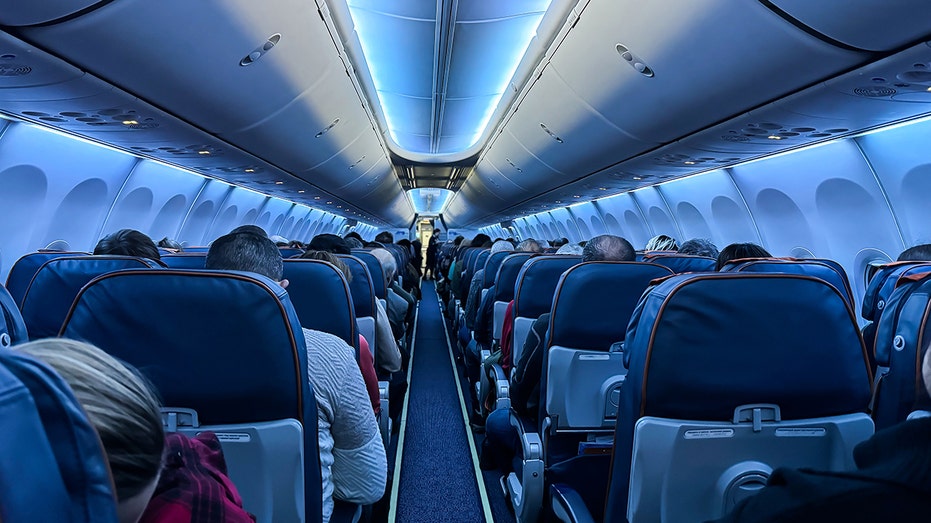
Not all flight routes are created equal when it comes to turbulence.
A recent report from turbulence tracking site Turbli ranked the most turbulence-prone flight routes in the U.S. and around the world in 2025.
The organization analyzed nearly 10,000 flight routes connecting more than 550 of the world’s largest airports — using recorded flight tracks and turbulence forecast data, the analysis said.
FLIGHT ANXIETY EASED WITH ONE SIMPLE MENTAL TRICK, SAYS AUTHOR AND PODCAST HOST MEL ROBBINS
Turbulence was measured using eddy dissipation rate (EDR), a standard aviation metric that captures how rough the air is during a flight.
Routes were ranked based on their average turbulence levels, with EDR values categorized as light, moderate, moderate-to-severe, severe and extreme.
The higher the average EDR score along a route — the more turbulence passengers are likely to experience, according to the analysis.
STANDING UP RIGHT AFTER PLANE LANDS FUELS VIRAL DEBATE ABOUT AIR TRAVEL ETIQUETTE
Here are the most turbulent routes in North America in 2025, according to the report.
The roughly 406-mile route recorded the highest average turbulence score in North America at 18.18, placing it in the light turbulence category.
ABQ to DEN spans about 349 miles. It recorded an average turbulence score of 18.18 as well, placing it in the light turbulence category.
CLICK HERE TO SIGN UP FOR OUR LIFESTYLE NEWSLETTER
In 2024, this route ranked the highest average turbulence with a score of 17.45, Turbli said.
This route covers roughly 205 miles and recorded an average turbulence score of 17.68, according to the data.
CLICK HERE FOR MORE LIFESTYLE STORIES
That places it within the light turbulence range based on eddy dissipation rate measurements.
Flights along this roughly 391-mile route drew an average turbulence score of 17.54.
That reading falls within the light turbulence range.
Flights between Bozeman and Denver logged an average turbulence reading of 17.22 over a distance of about 524 miles, placing the route in the light turbulence category.
TEST YOURSELF WITH OUR LATEST LIFESTYLE QUIZ
Outside the U.S., Turbli’s rankings showed turbulence was most pronounced on routes in South America and Asia, with several of the bumpiest flights crossing mountainous regions in Chile, Argentina and western China.
Routes in Europe, Oceania and Africa generally recorded lower average turbulence levels, though certain short-haul flights still ranked high within their regions.
While turbulence can feel alarming, the Federal Aviation Administration has noted that it is a normal part of air travel and is often unpredictable, even when skies appear clear.
The FAA advises passengers to keep seat belts fastened whenever they are seated, as most turbulence-related injuries occur when travelers are not buckled in.
Pilots and airlines also use weather data and forecasting tools to minimize exposure whenever possible.