
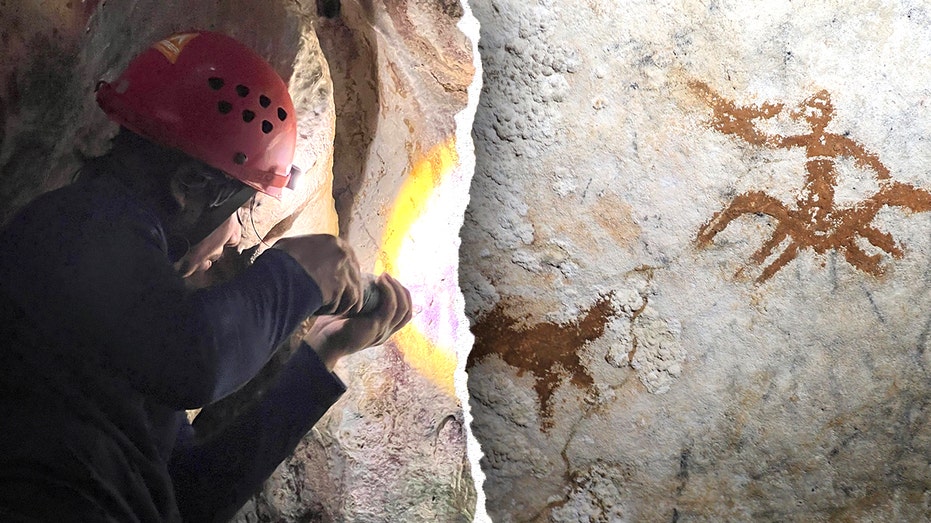
Researchers recently identified Indonesian cave art dating back about 68,000 years — a breakthrough discovery that marks one of the earliest known expressions of human creativity.
The rock art was found in a cave on the island of Sulawesi, a tropical island in central Indonesia, northeast of Java and Bali.
Pictures of the discovery show reddish-brown handprints — with some elongated or slightly pointed fingerprints on the cave wall.
The prints were created by blowing pigment over hands pressed against cave walls, with some fingertips intentionally modified.
The cave art, the researchers said, is the “oldest archaeological evidence revealed so far for the presence of our species” in the Wallacea region of Indonesia. The findings were published last week in the journal Nature.
Study author Maxime Aubert, an archaeologist at Griffith University in Australia, told The Associated Press the stencils may be evidence of a complex rock art tradition shared across different cultures.
TEST YOURSELF WITH OUR LATEST LIFESTYLE QUIZ
Researchers still aren’t sure what type of humans made the prints.
One possibility could be the Denisovans, an extinct group of early humans who lived in the region and may have interacted with Homo sapiens.
The prints could also have been made by modern humans whose ancestors traveled from Africa through the Middle East and into Indonesia.
Researchers said they plan to continue exploring the area for even older examples of ancient art.
CLICK HERE TO SIGN UP FOR OUR LIFESTYLE NEWSLETTER
Independent paleoanthropologist Genevieve von Petzinger, who was not involved in the study, told The Associated Press that she “let out a little squeal of joy” when she saw the findings.
“It fits everything I’d been thinking,” she said.
The discovery comes as researchers uncover increasingly older evidence of early human innovation.
CLICK HERE FOR MORE LIFESTYLE STORIES
“For us, this discovery is not the end of the story,” said Aubert. “It is an invitation to keep looking.”
In a similarly compelling discovery, researchers recently identified the world’s oldest-known poisoned arrowheads, which date back around 60,000 years.
Last month, researchers published evidence of the oldest-known deliberate fire-making by humans, which dates back around 400,000 years.
The Associated Press contributed reporting.